New to Financial Planning?
Let's Start With the Basics.
Financial planning isn't just for the wealthy. It's for everyone who wants to turn their income into lasting security and freedom.
Without a Plan
- ✗ Living paycheck to paycheck despite decent income
- ✗ Unsure if you're saving enough for retirement
- ✗ One emergency away from financial stress
- ✗ Buying insurance you don't understand
With a Plan
- ✓ Clear roadmap for your money and goals
- ✓ Confidence that you're on track for retirement
- ✓ Protected against life's unexpected events
- ✓ Right coverage at the right cost
Your Financial Journey in 4 Steps
Understand
Know where you are financially today
Protect
Secure yourself and loved ones first
Grow
Build wealth through smart investing
Legacy
Plan for generations ahead
Explore the Complete Guide
6-Step Process
Professional planning framework
Health Calculator
Check your financial score
Debt Management
Strategies to become debt-free
Goals
Set your vision
Cash Flow
Track money in/out
Emergency
Build safety net
Retirement
Plan your future
Legacy
Wealth transfer
Compounding
Grow exponentially
Common Misconceptions
Belief vs Reality
"I'm too young to start financial planning"
Starting early gives you the biggest advantage - compound interest works best over time. Even small amounts invested in your 20s can grow significantly by retirement.
"Financial planning is only for wealthy people"
Financial planning is about making the most of whatever you have. It's more important for those with limited resources to plan carefully to avoid costly mistakes.
"I can do it myself with online research"
Generic advice doesn't account for your specific situation - Singapore's unique CPF rules, tax reliefs, and government schemes require localized expertise.
The 6-Step Financial Planning Process
Based on the FPSB (Financial Planning Standards Board) international standards, this is the same framework used by Certified Financial Planners worldwide.
Establish Relationship
Define the scope and duration of engagement. Clarify responsibilities, competencies, and how the planner will be compensated.
- • Define services provided
- • Disclose potential conflicts
- • Clarify engagement terms
Gather Information
Collect quantitative data (income, assets, liabilities) and qualitative data (goals, risk tolerance, values, preferences).
- • Financial statements
- • Goals & priorities
- • Risk profile assessment
Analyse & Assess
Evaluate financial health using ratios and statements. Identify gaps, strengths, weaknesses, and potential threats.
- • Calculate financial ratios
- • Assess needs & priorities
- • Identify gaps & risks
Develop & Present
Develop strategies with alternatives. Present recommendations with pros, cons, risks, and time sensitivity.
- • Multiple scenarios
- • Pros & cons analysis
- • Written recommendations
Implement
Execute the agreed recommendations. Define timeline, amounts, responsibilities, and coordinate with other professionals.
- • Define action timeline
- • Assign responsibilities
- • Coordinate execution
Monitor & Review
Regular reviews to adapt to life changes, market conditions, new products, and evolving goals.
- • Annual reviews
- • Life event updates
- • Performance tracking
CFP® Professional Standard
This 6-step process is defined by the Financial Planning Standards Board (FPSB) and is the foundation of the CFP® certification.
Your 8 Key Financial Ratios
Financial planners use these 8 ratios to assess your financial health. Enter your numbers below to see where you stand.
📋 Quick Reference: 8 Financial Ratios
1. Basic Liquidity
Liquid Assets ÷ Monthly Expenses
Target: 3-6 months
2. Liquid-to-Net Worth
Liquid Assets ÷ Net Worth
Target: ≥15%
3. Savings Ratio
Monthly Savings ÷ Gross Income
Target: ≥10%
4. Debt-to-Asset
Total Debt ÷ Total Assets
Target: <50%
5. Solvency Ratio
Net Worth ÷ Total Assets
Target: ≥50%
6. Debt Service (DSR)
Debt Payments ÷ Take-home Income
Target: <35%
7. Non-Mortgage DSR
Non-Mortgage Debt ÷ Take-home Income
Target: <15%
8. Invested-to-Net Worth
Invested Assets ÷ Net Worth
Target: >50%
Chapter One
Goal Setting & Life Stage Planning
Life doesn't follow a linear path, and neither should your financial plan. Goal setting is about understanding where you are today, where you want to be, and creating a realistic path to get there.
Who This Is For
Individuals and families at different life stages, from fresh graduates starting careers to new parents balancing family needs or those approaching retirement.
Types of Financial Goals
🎯 Short-term (1-3 years)
Emergency fund, wedding, car, travel. Need liquid, low-risk solutions.
🏠 Medium-term (3-10 years)
Property down payment, children's education. Balance growth with accessibility.
🌅 Long-term (10+ years)
Retirement, legacy planning. Can afford higher risk for better returns.
🇸🇬 Singapore Context
In Singapore, life stages come with unique milestones: BTO applications, COE renewals, education planning for local or overseas universities, and CPF optimization for retirement.
💡 Pro Tips
- ✓ Review goals every 6-12 months, as priorities change when life evolves
- ✓ Focus on 2-3 priority goals at a time, not everything at once
- ✓ Write down goals and share with partner for accountability
- ✓ Build in buffer for unexpected opportunities or challenges
Chapter Two
Cash Flow & Budgeting
Cash flow is the lifeblood of your financial health. You could earn a high income but still struggle if cash flow isn't managed well. Understanding where your money goes is the first step to taking control.
Who This Is For
Individuals who earn well but feel uncertain about their progress, and anyone living paycheck to paycheck despite a good income.
The 50/30/20 Framework
50%
Needs
Housing, food, transport, utilities
30%
Wants
Lifestyle, entertainment, dining
20%
Savings
Savings, investments, debt repayment
Your Personal Budget Calculator
🇸🇬 Singapore Context
Singapore has one of the highest costs of living in Asia. Between housing loans, car expenses (COE, insurance), and lifestyle costs, even high earners can struggle. CPF contributions also significantly affect take-home pay.
💡 Pro Tips
- ✓ Pay yourself first: automate savings on payday
- ✓ Track expenses for 3 months to understand real spending patterns
- ✓ Review subscriptions quarterly. Unused ones are silent budget killers
- ✓ Use separate accounts for different purposes: daily, savings, investments, fun
Chapter Three
Emergency Fund Planning
An emergency fund is your financial shock absorber. It protects your investments from being liquidated at the wrong time and gives you options when life throws curveballs.
Who This Is For
Anyone without sufficient liquidity buffers, especially those using credit cards as emergency "funds".
How Much Do You Need?
3-6 months
Standard Recommendation
For dual-income households with stable employment
6-12 months
Higher Buffer Needed
Single income, self-employed, or volatile industries
🇸🇬 Singapore Context
Singapore has no unemployment insurance, making personal emergency funds critical. While MediSave covers some medical expenses, hospitalization deductibles can still cause significant out-of-pocket costs.
Where to Keep Your Emergency Fund
- • High-yield savings accounts: Digital banks offering 2-4% interest
- • Singapore Savings Bonds: Redeemable anytime with no penalty
- • Money market funds: Slightly higher returns, still liquid
⚠️ What's NOT an Emergency Fund:
CPF (can't withdraw), stocks (too volatile), fixed deposits (locked), credit cards (that's debt, not savings)
Financial Foundation
Debt & Credit Management
Debt isn't inherently bad - it's a tool. Used wisely, debt can help you build wealth (mortgages, education loans). Used poorly, it can trap you in a cycle of payments. Understanding the different types of debt and how to manage them is essential.
Who This Is For
Anyone with existing debt, those considering taking on debt (mortgage, car, education), or those who want to optimize their debt repayment strategy.
Types of Consumer Debt
Credit Cards
Revolving credit with daily compounding interest (typically 24-26% p.a.).
- • Pre-approved limit up to 4x monthly income
- • No fixed tenure = easy to stay in debt
- • Interest kicks in if not paid in full
⚠️ Highest cost debt - avoid carrying balances
Revolving Credit
Pre-approved credit line you can draw from repeatedly.
- • Like credit cards but separate facility
- • No fixed tenure for repayment
- • Interest compounds your balance
⚡ High risk of debt spiral
Term Loans / Instalments
Fixed repayment schedule over a set period.
- • Hire-purchase agreements
- • 0% instalment plans (often have hidden costs)
- • Personal loans with fixed tenure
✓ Predictable payments, manageable
Secured Loans
Loans backed by collateral (property, car).
- • Mortgage (home loan)
- • Car loans secured by vehicle
- • Lower interest due to collateral
✓ Good debt if asset appreciates
✓ "Good" Debt
-
•
Mortgage
Builds equity, property appreciates long-term
-
•
Education Loan
Increases earning potential
-
•
Business Loan
Generates income if business succeeds
✗ "Bad" Debt
-
•
Credit Card Balances
24%+ interest on depreciating items
-
•
Payday Loans
Extremely high interest, debt trap
-
•
Luxury Car Loans
Depreciating asset, high COE cost
🇸🇬 Singapore Debt Regulations
- TDSR (Total Debt Servicing Ratio): Max 55% of gross income for property loans
- MSR (Mortgage Servicing Ratio): Max 30% for HDB loans
- Credit Card Limits: Up to 4x monthly income (2x if income <$30K)
- Unsecured Debt Cap: Max 12x monthly income for unsecured borrowing
Debt Payoff Strategies
Avalanche Method
Mathematically optimal
Pay minimum on all debts, then put extra towards the highest interest rate debt first.
Best for: Saving the most money on interest
Snowball Method
Psychologically motivating
Pay minimum on all debts, then put extra towards the smallest balance first for quick wins.
Best for: Building momentum and motivation
💡 Pro Tips
- ✓ Balance transfer: Move high-interest debt to 0% promotional cards to save on interest
- ✓ Refinance: If rates have dropped, consider refinancing your mortgage
- ✓ Automate payments: Avoid late fees and credit score damage
- ✓ Don't just pay minimum: Credit card minimum payments can take 10+ years to clear
- ✓ Build emergency fund first: Avoid going into debt for emergencies
⚠️ Warning Signs of Debt Trouble:
- • Paying only minimum on credit cards
- • Using credit to pay other debts
- • Debt service ratio above 35%
- • No idea how much you owe
- • Avoiding looking at statements
- • Borrowing from family/friends
If you recognize these signs, consider speaking to a financial counsellor or Credit Counselling Singapore (CCS).
Chapter Four
Retirement Planning
Retirement planning ensures you can maintain your desired lifestyle when active income stops. With increasing life expectancy, retirement could last 20-30 years. The question isn't just whether you can retire, but whether you can afford to stay retired.
Who This Is For
Pre-retirees planning their next chapter, and anyone who wants to stop working someday (that's everyone!).
Key Retirement Concepts
📊 The 4% Rule
Withdraw 4% of portfolio annually. In low-interest times, 3-3.5% may be safer.
🏥 Healthcare Costs
Medical expenses typically double every 8-10 years. Plan for significantly higher costs.
📈 Inflation Impact
At 3% inflation (Singstat), $5,000 today = $2,200 purchasing power in 30 years.
🇸🇬 Singapore Context
CPF provides a foundation through CPF LIFE payouts, but for most people, CPF alone is insufficient for a comfortable retirement. The Full Retirement Sum of $220,400 (2026) provides approximately $1,600 to $1,800 per month, often inadequate for desired lifestyles.
💡 Pro Tips
- ✓ Start planning 10-15 years before target retirement to maximize compounding
- ✓ Consider part-time work in early retirement to reduce portfolio withdrawal
- ✓ Do a "retirement trial run": live on projected budget for 6 months before retiring
- ✓ Build multiple income streams: CPF LIFE, investments, rental income
Chapter Five
Estate & Legacy Planning
Estate planning isn't just for the wealthy. It's for anyone who wants control over what happens to their assets and loved ones after they're gone. Without proper planning, your assets may be distributed according to laws rather than your wishes.
Who This Is For
Individuals who value clarity and control over asset distribution, especially those with dependents or significant assets.
Essential Estate Planning Tools
📜 Will
Legal document specifying how your assets should be distributed. Simple and essential.
🏛️ Trust
More control, privacy, and avoids probate. Better for complex situations.
📋 LPA
Lasting Power of Attorney: appoint someone to decide for you if you can't.
🇸🇬 Singapore Context
Singapore follows the Intestate Succession Act for non-Muslims. Without a will, your estate follows fixed rules that may not match your intentions. CPF and insurance pass by nomination, NOT by will. Ensure these are aligned!
💡 Pro Tips
- ✓ Update your will after major life events such as marriage, divorce, or childbirth
- ✓ Create an LPA before you need it. You can't after losing mental capacity
- ✓ Keep a list of all assets and locations for your executor
- ✓ Review CPF and insurance nominations annually
Chapter Six
The Power of Compounding
The power of compound interest is often called the eighth wonder of the world. This chapter demonstrates why starting early, even with smaller amounts, can result in more wealth than starting later with larger investments.
The Rule of 72
Divide 72 by your annual return rate to estimate how many years to double your money. At 8% returns, your money doubles every 9 years.
See Your Money Double
At this rate, your money doubles every
Starting with $5,000 at age 30, you could have $640,000 by age 93
The Basic Financial Planning Guide
Developed by MAS, MoneySense, CPF Board, and industry associations to help everyone in Singapore (Citizens, PRs, and Work Pass holders) plan their finances at every life stage.
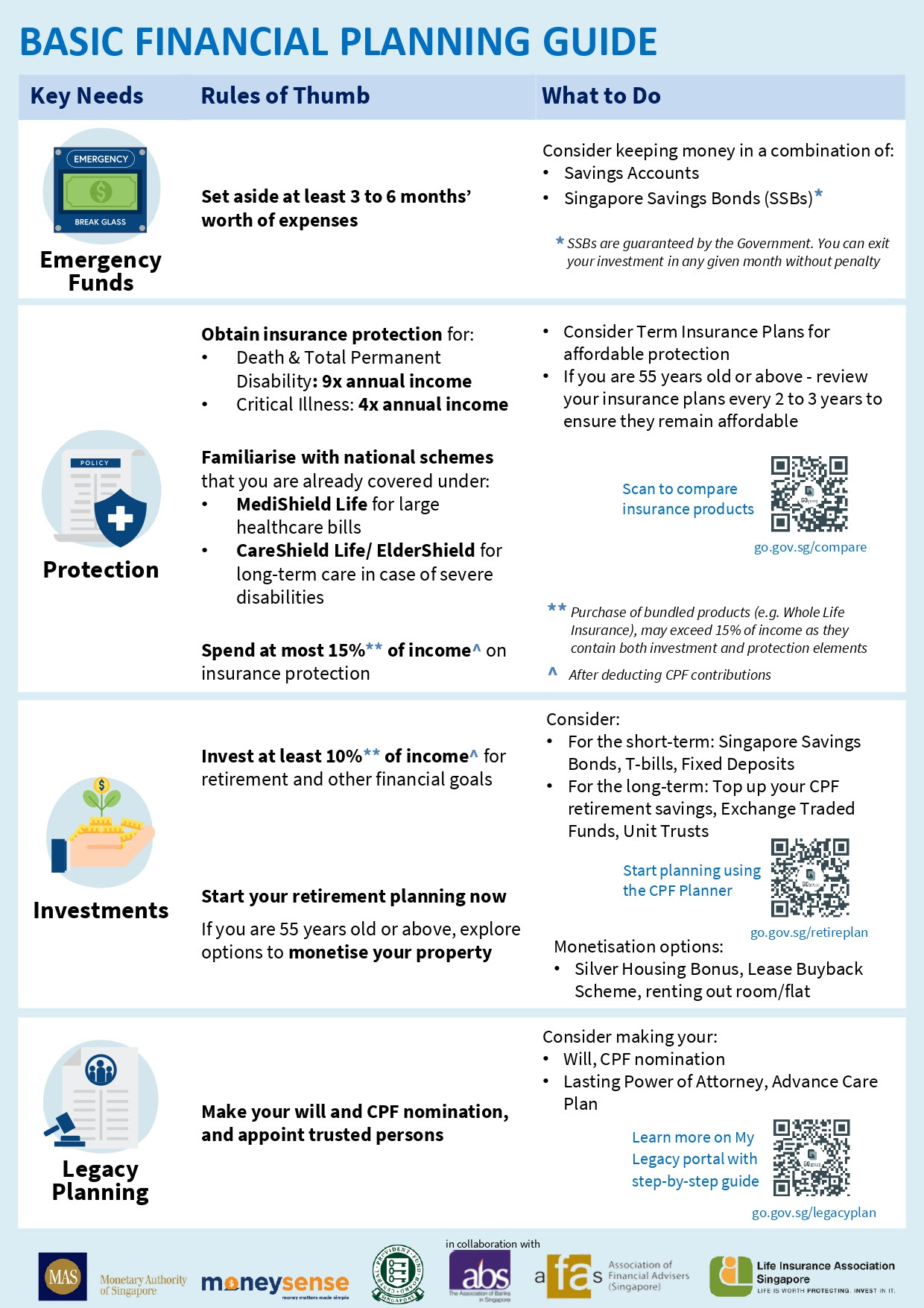
📄 Official guide by MoneySense & MAS
Why This Guide Matters for Everyone in Singapore
Official Government Framework
Endorsed by MAS and developed with CPF Board, ABS, AFA, and LIA to provide trusted, unbiased guidance.
Life Stage Specific
Tailored advice for young adults, families, sandwich generation, pre-retirees, and retirees.
Clear Rules of Thumb
Simple benchmarks for savings, insurance, and investments that anyone can follow.
📋 Key Financial Planning Guidelines
Emergency Fund
3-6 months
of expenses set aside for emergencies
Death & TPD Cover
9x Income
to protect your dependants
Critical Illness
4x Income
coverage for major illnesses
Investments
≥10%
of income for retirement goals
Insurance Budget Rule: ≤15% of Income
According to the guide, spend at most 15% of your income on insurance protection. This ensures you have enough for savings and investments while staying adequately protected.
Source: MoneySense.gov.sg | A Singapore Government initiative by MAS
Two Friends, Same Goal: Who Wins?
Both invest $1,000/year at 8% returns. But one secret changes everything...
Chapter 1
Meet the Early Bird & the Late Starter
Early Bird
The Wise One
Starts investing at Year 1
Invests $1,000/year for 10 years
Then stops completely and just watches
Late Starter
The Procrastinator
Waits until Year 11 to start
Invests $1,000/year for 20 years
Never stops and keeps going strong
Quick! Who has more at Year 30?
Chapter 2
Fast Forward 30 Years...
Early Bird
Invested $10,000 total
Final Value at Year 30
$72,922
Late Starter
Invested $20,000 total
Final Value at Year 30
$49,422
+$23,500 More!
Despite investing half the money, Early Bird ends up with 47% more wealth.
$10K
Less invested
$23.5K
More wealth
10 yrs
Head start
Chapter 3
The Secret Behind the Numbers
It's Not About the Money. It's About Time
Early Bird's first $1,000 had 30 years to compound. Late Starter's first $1,000 only had 20 years. That 10-year head start is worth more than $10,000 of extra contributions.
Time in the market
beats timing the market
Start small, start early
beats start big, start late
Every year you wait costs you exponentially.
Chapter 4
Now Try It Yourself
Adjust the numbers below and see how different scenarios play out over time.
Your Inputs
Results
Early Bird
Invested: $10,000
$72,922
ROI: 629%
Late Starter
Invested: $20,000
$49,422
ROI: 147%
Early Bird Advantage
Despite investing $10,000 less!
+$23,500
Growth Over Time
Ready to Take Control of
Your Financial Future?
Join hundreds of Singaporeans who've built lasting wealth with personalized guidance. Your journey starts with a simple conversation.